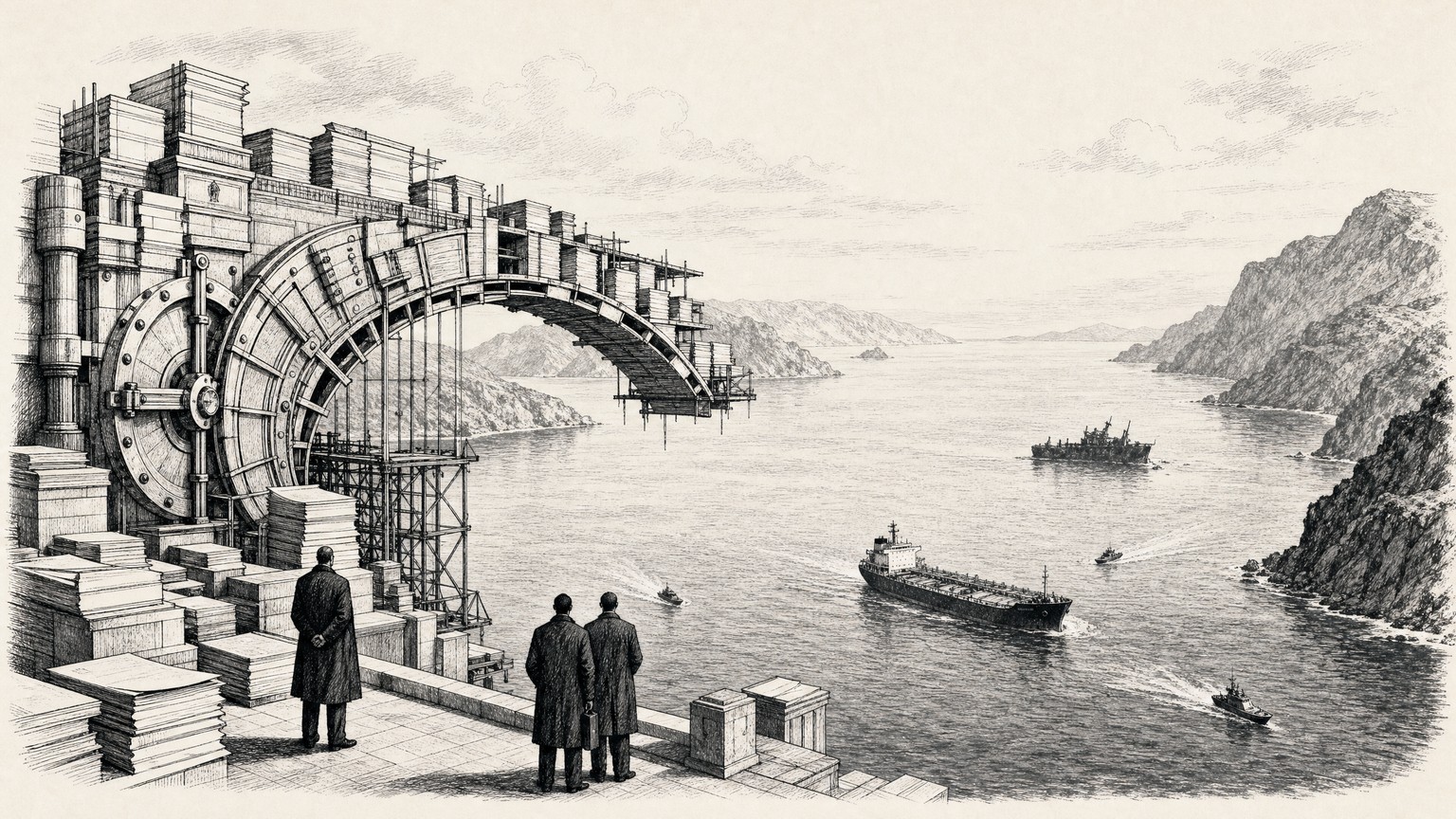
The week's real signal is a sequencing mismatch: the financial, legal, and diplomatic instruments of a post-war Iran settlement have been pre-positioned weeks ahead of any signed text or physical Hormuz reopening, while the falsifying evidence — near-zero strait traffic, continued tanker strikes, an unstarted 60-day verification clock, and no Khamenei endorsement — remains stubbornly physical. Markets priced the announcement with a $10-plus weekly Brent collapse and a Goldman forecast cut; the instruments that actually bind a settlement have not closed. The durable trade is therefore fading the paper-versus-physical gap rather than chasing crude lower. The single observable that would prove this wrong is a clean reopening confirmed by sustained Hormuz throughput and a Khamenei-level signature — neither of which arrived this week.
The consensus read of the week is simple and, we think, premature: a ceasefire is near, oil cracked more than fourteen dollars across both benchmarks, Goldman cut its forecast, and the war premium is being written out of base cases. The obvious conclusion is to short the war premium and buy Gulf risk. We read the same week differently. The most concrete, verifiable evidence of de-escalation this week was not in the price tape at all — it was institutional, financial, and legal. The most concrete evidence that the de-escalation is not yet durable was physical and kinetic. The mispricing sits in the gap between those two tracks, not in the direction of crude.
Consider what actually closed versus what merely advanced. On the institutional side, the UAE agreed to unlock billions of dollars for Iran — corroborated across Reuters, Al-Monitor, AGBI and Iranian state outlet ISNA — a capital-flow instrument moving toward Tehran while CENTCOM was still downing Iranian drones over Hormuz. Washington asked a US court to drop its highest-profile Iran sanctions-evasion case against Turkey's Halkbank, even as it simultaneously designated China-based Iran-linked firms. That contradiction is itself the signal: sanctions relief is being assembled selectively as negotiation currency, not rolled back wholesale. And a Qatari-Pakistani diplomatic channel demonstrably moved Trump off a strike order within hours. These are the instruments that build a settlement's plumbing, and they are being laid before any signature.
Now consider what has not closed. Iran's deputy foreign minister Gharibabadi stated the 60-day negotiation clock begins only after Tehran verifies Washington has met its war-ending obligations — meaning the clock has not even started. Hardliners and street protesters publicly rejected the framework while Araghchi urged media not to speculate on its content, pointing to a domestic ratification problem rather than merely a US compliance one. Al-Mayadeen's coverage was defensive-transactional, foregrounding the conditions Tehran imposes rather than concessions it made — the posture of a regime managing a face-saving exit, not one declaring victory. Crucially, there is no public Khamenei-level endorsement, and the AFP-reported July 9 burial of the late supreme leader is a reminder that Tehran's own succession and authority structure is unsettled at precisely the moment a signature is needed.
The physical reality lags the paper relief by weeks. Windward AIS data cited by Hellenic Shipping News showed only one commercial crossing of the Strait of Hormuz between 11 and 14 June, with IRGC small-craft activity surging and covert export infrastructure still operating under US enforcement. A single Iran-linked transit on 15 June is thin evidence of reopening, not proof of it. Meanwhile the kinetic track ran in parallel rather than in sequence with the diplomacy: the US disabled an Iran-bound tanker in the Gulf of Oman the same day it cancelled air strikes, a second hull was hit within 24 hours, and India summoned the US deputy chief of mission over strikes on Indian-crewed vessels. Maritime enforcement is standing policy that ceasefire headlines do not extend to — and war-risk underwriters know it.
The Lebanon track is the named sequencing sticking point and the most plausible trigger to reverse the entire oil slide. Israel struck Beirut on the very day a deal could have been signed; Trump reportedly told Israel to stop, warning it risked derailing the Iran agreement. The WSJ flagged the unresolved Lebanon conflict as a direct obstacle to finalising the text. A signed page on Iran does not switch off the Levant, and a market that has already removed the war premium has no cushion for an uncontrolled Hezbollah-Israel escalation.
There is a further reason to doubt the depth of the move lower. Vortexa's reassessment that real lost supply was far below the widely cited 10-million-barrel-per-day headline suggests the June spike was partly a measurement and liquidity scare — flows strengthened as alternative logistics scaled, evidenced by Saudi jet fuel to Europe exceeding pre-closure levels, rerouting through Suez, and Trafigura and Vitol moving more Venezuelan and Omani barrels. If the outage was always smaller than priced, the current $82 Brent may already overshoot to the downside, independent of whether the deal closes. That matters most for Gulf budget planners who set spending against panic-period assumptions and now face the opposite distortion.
We acknowledge the strongest competing reading: that this is a clean de-escalation, the war premium is genuinely gone, and the structural Gulf story — sovereign capital deploying into AI infrastructure and European renewables through the conflict — is the real signal. That diversification cadence (KIA-KKR-Nvidia, Masdar-Repsol, AD Ports into Alexandria) is real and confirms confidence, but it is slow-moving and does not resolve the week's central uncertainty. The clean-de-escalation thesis stands or falls only on the price tape, and the tape has front-run a settlement that no signed text, no Khamenei endorsement, and no physical Hormuz reopening confirms. The single observable that distinguishes our read from the consensus is whether a named signing date plus a public leadership-level endorsement materialise within two weeks, reconciled by Hormuz throughput sustaining above thirty crossings a day. Absent both, the deal is an expectation, not an instrument, and the relief sits on sentiment alone.
Several load-bearing items are single-source or pending corroboration — the scale of the UAE-unlocked funds, the civilian-nuclear concession detail, the Vortexa supply revision, and the Iraqi 3mbd export drop should be treated as directional rather than confirmed. The central call rests on a sequencing argument that resolves only over the coming two weeks; we cannot confidently say whether the framework survives Tehran's ratification politics, and the Khamenei succession backdrop (reported July 9 burial) adds an authority-structure uncertainty that no source this week resolved. This is a high-conviction call on the paper-versus-physical gap, not on the ultimate direction of the deal.
For information only. Iveris published intelligence is not investment, legal, tax, or compliance advice, and is not a recommendation to buy or sell any security or instrument. Conduct your own due diligence.